

How to Stop Cat Scratching Furniture: A Practical Guide
Table of Contents
- Why Cats Scratch Furniture (and Why Punishment Fails)
- Best Cat Scratching Post Materials for Your Home
- How to Redirect Cat Scratching Behavior to Appropriate Surfaces
- Deterrents and Repellents: What Actually Works
- How to Trim Cat Nails Safely (Step-by-Step)
- Furniture Protection and Repair: Fabric-Specific Strategies
- Multi-Cat Households and Age-Specific Scratching Challenges
- Conclusion: Building a Scratch-Free Home That Works for Your Cat
- Frequently Asked Questions
Last Updated: September 15, 2026
Why Cats Scratch Furniture (and Why Punishment Fails)
Learning how to stop cat scratching furniture starts with understanding that scratching is not misbehavior, and the same holds when you want to stop cat scratching in general. It is a normal, instinctive activity cats use for claw maintenance, territorial marking, and stretching (Destructive Scratching). When a cat digs its claws into your sofa arm, it is depositing scent from glands in its paws while shedding the outer layer of its claws.
Punishment does not work because it addresses none of those needs. Spraying water, yelling, or tapping a cat's nose teaches fear and can trigger stress-induced scratching, which makes the problem worse (avma). The American Society for the Prevention of Cruelty to Animals guidance on cat behavior confirms that cats cannot connect delayed punishment to an earlier action, so they simply learn to scratch when you are not watching.
The fix is redirection, not suppression. Cats scratch because they need to, so the goal is giving them somewhere better to do it.
Best Cat Scratching Post Materials for Your Home
The best cat scratching post materials are sisal rope, corrugated cardboard, and carpet, and the right choice depends on your cat's texture preference. Watch where your cat already scratches: couch corners suggest a vertical preference, while carpet edges suggest horizontal scratching.
Sisal Rope vs. Corrugated Cardboard vs. Carpet
Each material has trade-offs worth knowing before you buy.
| Material | Durability | Best For | Watch Out For |
|---|---|---|---|
| Sisal rope | High | Vertical posts, heavy scratchers | Loose strands if poorly wrapped |
| Corrugated cardboard | Low | Horizontal pads, trial testing | Frequent replacement |
| Carpet | Medium | Budget setups | Can teach cats to scratch rugs |
Sisal rope holds up longest and satisfies vertical scratching well. Corrugated cardboard is cheap and great for testing whether your cat prefers horizontal scratching, but it sheds and needs replacing often. Carpet works, though a common mistake is using the same carpet as your floor, which teaches your cat that all carpet is fair game.
Vertical vs. Horizontal Scratching Surfaces
Most cats want both. A tall vertical post lets a cat stretch fully, while a horizontal pad or scratching pad serves cats that like to dig low. Buy one of each and note which gets more use. That tells you what to invest in next.
How to Redirect Cat Scratching Behavior to Appropriate Surfaces
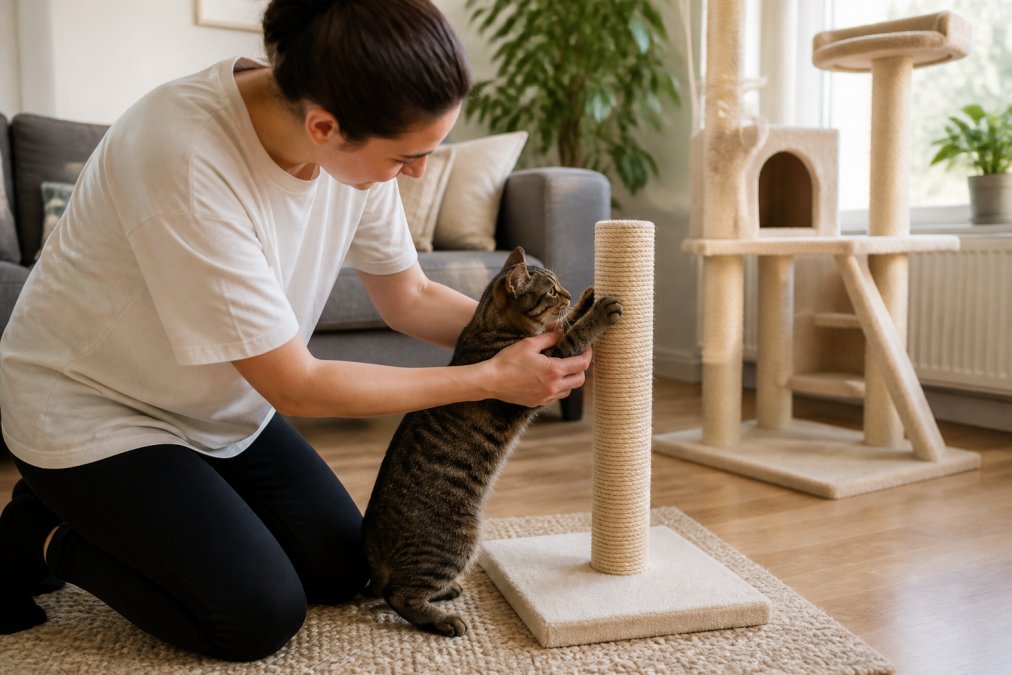
Redirecting scratching works when you make the approved surface more appealing than the furniture, then reward the switch. Cats repeat what feels good and gets attention.
Placement, Play, and Positive Reinforcement
Placement decides whether a scratching post gets used at all. Follow these steps:
- Move the post next to the furniture your cat already targets
- Play with a wand toy around the post so your cat associates it with fun
- Sprinkle catnip or silvervine on the surface to draw interest
- Reward every scratch on the post with praise or a treat
- After a week of consistent use, shift the post a few inches toward its permanent spot
Positive reinforcement beats correction every time. Clicker training works well here: click and treat the moment claws touch the post, and most cats catch on within days. Behavioral modification takes patience, but it sticks.
Deterrents and Repellents: What Actually Works
Deterrents buy you time while redirection does the real work. No deterrent fixes scratching on its own, but the right combination protects furniture during the training period. The key is understanding why each one works, so you can pick the cheapest option that fits your cat.
How Each Deterrent Actually Works
- Double-sided tape: Cats dislike the sticky sensation on their paws. The mechanism is tactile, not scent-based, so it works on cats that ignore sprays. It is the cheapest option and the easiest to test.
- Deterrent sprays: Citrus, herbal, and other scent-based formulas work by making the surface unpleasant to investigate. Effectiveness varies by cat, and the scent fades, so reapplication every few days is usually necessary.
- Visual and tactile barriers: Aluminum foil, plastic sheeting, and furniture guards work by changing how the surface feels and sounds. Foil is cheap and effective but looks temporary; purpose-made guards look cleaner and last longer.
- Pheromone diffusers: These do not deter scratching directly. They reduce overall stress, which lowers stress-induced scratching. They work best as a background measure alongside redirection.
What Rarely Works and Why
Scented candles, loud noises, and motion-activated devices that fire unpredictably tend to increase stress rather than reduce scratching. Stress-induced scratching is harder to fix than the original habit, so these are usually a net negative. Punishment-based deterrents also teach cats to scratch when you are not watching, which defeats the purpose.
DIY vs. Store-Bought: The Cost and Effectiveness Question
Budget-conscious owners want to know whether expensive deterrents beat household hacks. For most cats, the honest answer is that DIY options like double-sided tape, foil, and a spray bottle of diluted citrus perform about as well as store-bought deterrents during the training period. Store-bought products win on convenience and appearance, not on raw effectiveness. A practical approach is to start with DIY tape and foil, see which spots your cat targets, then invest in a purpose-made guard or slipcover only for the surfaces that need long-term protection. That keeps spending focused where it actually changes behavior.
Cleanup Matters as Much as Deterrence
An enzymatic cleaner removes the scent residue that draws cats back to the same spot. Regular household cleaners often leave traces your cat can still smell, which is why a spot can keep attracting scratching even after you clean it. Treat the spot with an enzymatic cleaner before applying any deterrent, or you are fighting the cat's nose as well as its claws.
How to Trim Cat Nails Safely (Step-by-Step)
Trimming cat nails reduces the damage scratching causes and takes about five minutes once your cat is comfortable. Even a redirected cat can catch a claw on fabric, so regular nail trimming is part of the routine.
What You'll Need:
- Sharp nail clippers designed for cats
- Styptic powder in case you cut too close
- A towel and treats
- Sit your cat in your lap or on a stable surface, calm and relaxed
- Press a paw gently to extend one claw
- Locate the pink quick inside the claw and stay well clear of it
- Clip only the clear, curved tip at a slight angle
- Reward with a treat and move to the next claw
- Stop after one paw if your cat is stressed, and continue tomorrow
If trimming feels risky, nail caps are a humane alternative. They glue over the claw and blunt the damage without restricting natural behavior. A good pair of nail clippers and a steady hand make this far easier than most owners expect.
Furniture Protection and Repair: Fabric-Specific Strategies
Furniture protection should match your fabric, because a strategy that saves leather can ruin velvet.
Leather and Faux Leather
Microfiber and Tight-Weave Upholstery
Velvet, Chenille, and Other Loop-Pile Fabrics
Wood, Wicker, and Rattan
DIY vs. Store-Bought: What the Trade-Off Actually Is
Multi-Cat Households and Age-Specific Scratching Challenges
Conclusion: Building a Scratch-Free Home That Works for Your Cat
Frequently Asked Questions
How do I stop a cat from scratching my couch?
Start by placing a scratching post directly next to the couch spot your cat targets. Cats scratch where they already feel territorial, so moving the post to that exact location makes the transition easier. Cover the couch area with double-sided tape or a temporary throw while your cat learns. Reward every scratch on the post with a treat or praise. Most cats adjust within two to four weeks of consistent redirection.
What repels cats from scratching furniture?
Cats avoid surfaces that feel unstable or smell unpleasant to them. Double-sided tape works because cats dislike the sticky texture on their paws. Citrus or menthol deterrent sprays can help, but test on a hidden area first. Pheromone diffusers reduce stress-related scratching. Visual deterrents like aluminum foil or plastic sheeting also work short-term. Combine two or three methods for the best results, and always pair them with a scratching post alternative.
Is it normal for cats to scratch furniture?
Yes. Scratching is a natural behavior cats use for claw maintenance, territorial marking, and stretching. Scent glands in their paws leave pheromone signals, which is why they return to the same spots. The goal is not to stop scratching entirely but to redirect it to appropriate surfaces. A cat that never scratches may be stressed or unwell. Providing the right scratching post materials and placement lets your cat scratch without destroying your furniture.
How do I train my cat to use a scratching post instead of the sofa?
Place the post beside the sofa and make it more appealing than the furniture. Dangle a toy along the post, rub catnip or silvervine on the sisal, and gently guide your cat's paws onto the surface. Use clicker training or treats to mark and reward every scratch on the post. Never punish scratching on the sofa; instead, calmly redirect. Consistency matters more than intensity, and most cats respond within a few weeks.